Online Baccarat in Canada
How punto banco works, what the cards count, when each hand takes a third card and what the Banker, Player, Tie and pair bets cost. The deal illustration uses the real drawing rules and an eight-deck shoe.
- First two cards Player Q + 10 = 0, Banker 10 + 6 = 6. No natural 8 or 9, so the drawing rules apply.
- Player rule The Player has 0 and draws (0 to 5 draws). Third card 7: total 7.
- Banker rule The Banker has 6 and the Player’s third card is a 7: the Banker draws (on 6 it draws only against a 6 or 7). Third card 6: total 2.
- Result Player hand higher, 7 against 2.
Illustration only: no bets, no money and no balance. Cards come from a shuffled eight-deck shoe; the first card burns as many cards as it counts (10 for a 0), and a new shoe starts at the cut card.
- 1.06% house edge on the Banker bet, after the 5% commission (8 decks)
- 1.24% house edge on the Player bet, paid at 1 to 1
- 14.36% house edge on a Tie bet paid at 8 to 1
What online baccarat is
Baccarat is a card game in which you bet on which of two hands, Player or Banker, will finish with the total closer to 9, or on a tie. Once the cards are out nobody makes a decision: fixed rules say whether each hand takes a third card. The version offered online is punto banco, either as an RNG game, where software deals from a virtual shoe, or as a live game streamed from a studio. The rules and the payouts are the same in both.
- 1
Two hands, not two people
Player and Banker are only the names of the two hands. You are not the Player and the casino is not the Banker: you can back either hand, or a tie, and the casino books every bet.
- 2
Count the last digit
An ace counts 1, the cards 2 to 9 count their face value, and tens and picture cards count 0. A total above 9 keeps only its last digit, so 7 + 8 = 15 counts as 5. The highest total is 9.
- 3
Rules, not choices
An 8 or 9 on the first two cards is a natural and ends the round. Otherwise the Player hand draws on 0 to 5, and the Banker’s draw depends on its total and on the Player’s third card.
Card values and totals
Suits play no part in the main game. Only the value of each card counts, and only the last digit of the total.
| Card or total | Counts as | Example |
|---|---|---|
| Ace | 1 | A + 6 = 7 |
| 2 to 9 | Face value | 4 + 3 = 7 |
| 10, jack, queen, king | 0 | K + 7 = 7 |
| Two-card total of 10 or more | Last digit only | 8 + 6 = 14, counts as 4 |
| Three-card total of 10 or more | Last digit only | 9 + 5 + 9 = 23, counts as 3 |
How a round works
An RNG table and a live table follow the same five steps. At an RNG table you start the deal yourself; at a live table the round runs on a betting timer.
Bet on Player, Banker or Tie
Check the table limits and the payouts in the help screen, and decide in advance how much you are prepared to spend. Side bets such as Player pair and Banker pair sit next to the three main boxes.
Two cards to each hand
Cards come from a shoe, usually of eight decks, in the order Player, Banker, Player, Banker. Both hands are dealt face up, and each shows its total.
Check for a natural
If either hand totals 8 or 9, both hands stand and the round is decided on those two cards.
Third cards by rule
The Player hand draws on 0 to 5 and stands on 6 or 7. The Banker hand then draws or stands according to the table in the explorer below. Each hand takes at most one extra card.
Bets are settled
Banker bets pay even money minus a 5% commission (0.95 to 1), Player bets pay 1 to 1 and Tie bets usually 8 to 1. On a tie, Player and Banker bets are returned. The next hand does not depend on this one.
Third-card rule explorer
The Banker’s drawing rule is the only part of baccarat that looks complicated. Pick the Player’s third card (or that the Player stood) and the Banker’s two-card total, or tap any cell of the table, to see what the Banker does and why. The Player’s own rule is shown underneath.
A third card of 0 is a 10, jack, queen or king. Banker totals of 8 and 9 are naturals, so the round ends before any third card is drawn.
| Banker | St | 0 | 1 | 2 | 3 | 4 | 5 | 6 | 7 | 8 | 9 |
|---|---|---|---|---|---|---|---|---|---|---|---|
| 0 | |||||||||||
| 1 | |||||||||||
| 2 | |||||||||||
| 3 | |||||||||||
| 4 | |||||||||||
| 5 | |||||||||||
| 6 | |||||||||||
| 7 |
- D: Banker draws
- S: Banker stands
- St: the Player stood on 6 or 7
Banker 5, Player’s third card 4
With 5 the Banker draws when the Player’s third card is 4, 5, 6 or 7, and stands against 0 to 3, 8 or 9.
- 0 to 5 draws a third card
- 6 or 7 stands
- 8 or 9 natural: nobody draws
Bets, payouts and house edge
Three main bets and a few common extras. The figures are for an eight-deck shoe and count every hand dealt, ties included. Pick a bet below to see how often it pays, when it is returned and what it costs on average.
| Bet | Pays | How often it pays | House edge | Average cost per C$100 bet |
|---|---|---|---|---|
| Banker | 0.95 to 1 (5% commission) | 45.86% of hands; returned on a tie (9.52%) | 1.06% | C$1.06 |
| Player | 1 to 1 | 44.62% of hands; returned on a tie (9.52%) | 1.24% | C$1.24 |
| Banker, no commission | 1 to 1, but 1 to 2 when the Banker has 6 | 40.47% at 1 to 1, 5.39% at 1 to 2; returned on a tie | 1.46% | C$1.46 |
| Tie at 9 to 1 | 9 to 1 | 9.52% of hands | 4.84% | C$4.84 |
| Player pair or Banker pair | 11 to 1 | 7.47% of hands | 10.36% | C$10.36 |
| Tie at 8 to 1 | 8 to 1 | 9.52% of hands | 14.36% | C$14.36 |
Eight decks. House edge per hand dealt, ties included; Banker and Player bets that are returned on a tie count as hands with no cost. Source: Wizard of Odds baccarat analysis.
Banker bet
- 45.86% Banker hand higher: paid 0.95 to 1
- 9.52% Tie: the bet is returned
- 44.62% Player hand higher: the bet is lost
The Banker hand comes out ahead more often because it draws after seeing the Player’s third card. Without the commission the bet would favour the player, so the casino keeps 5% of every Banker payout.
Player bet
- 44.62% Player hand higher: paid 1 to 1
- 9.52% Tie: the bet is returned
- 45.86% Banker hand higher: the bet is lost
No commission, but the Player hand comes out ahead slightly less often than the Banker hand. The gap of 1.24 points between the two is the whole house edge.
Banker bet without commission
- 40.47% Banker hand higher with any total but 6: paid 1 to 1
- 5.39% Banker hand higher with 6: paid 1 to 2
- 9.52% Tie: the bet is returned
- 44.62% Player hand higher: the bet is lost
The commission disappears, but the half payout on a Banker 6 costs more than it saves: 1.46% against 1.06%. Other commission-free rules exist, so check the help screen for the exact one.
Tie bet paid at 9 to 1
- 9.52% Equal totals: paid 9 to 1
- 90.48% Either hand higher: the bet is lost
Some tables pay ties at 9 to 1. One extra unit on the payout cuts the edge to about a third of the usual 8 to 1 Tie, but it stays well above the Banker and Player bets.
Player pair or Banker pair
- 7.47% First two cards of that hand are the same rank: paid 11 to 1
- 92.53% No pair: the bet is lost
A side bet on the first two cards of one hand, for example two sevens or two kings (a king and a queen is not a pair). It does not depend on which hand is higher.
Tie bet paid at 8 to 1
- 9.52% Equal totals: paid 8 to 1
- 90.48% Either hand higher: the bet is lost
The usual Tie payout. A tie comes up about once in 10.5 hands, so a fair payout would be about 9.5 to 1; paying 8 to 1 makes this the costliest standard bet on the table.
What each bet costs over many hands
- Banker 1.06% house edge, 5% commission C$1.06
- Player 1.24% house edge C$1.24
- Banker, no commission 1.46% house edge, 1 to 2 on a 6 C$1.46
- Tie at 9 to 1 4.84% house edge C$4.84
- Player or Banker pair 10.36% house edge at 11 to 1 C$10.36
- Tie at 8 to 1 14.36% house edge C$14.36
The figure is the long-run average the game keeps from the total amount bet. It is not a prediction: a single session can end well above or well below it. Money that is bet again counts towards the total every time it is bet. The bet picked above is highlighted.
The main variants
Studios give their tables many names, but almost all of them are punto banco underneath. What changes is the pace, the presentation and sometimes the payout on one bet.
The standard game behind almost every online table: fixed drawing rules, usually eight decks, Banker 0.95 to 1, Player 1 to 1 and Tie 8 to 1.
The same rules on a smaller table. One dealer turns over all the cards, so rounds are quicker and minimums tend to be lower. With the same number of decks the odds do not change.
A live table with a shorter betting window and faster reveals. Evolution gives about 27 seconds a round, against about 48 at its standard tables. Same rules and payouts, so more hands an hour and, at the same stake, a higher total amount bet.
Banker bets pay 1 to 1 with no 5% deduction, except when the Banker hand comes out ahead with 6, which pays 1 to 2. That puts the Banker edge at 1.46%; the Player bet is unchanged.
Real cards dealt from a shoe in a studio and streamed with the scorecards on screen. Bets close on a timer, and the rules and payouts match the RNG game. Some tables add multipliers: Evolution’s Lightning Baccarat puts random 2x to 8x multipliers on one to five cards per round and charges a 20% fee on every bet to pay for them.
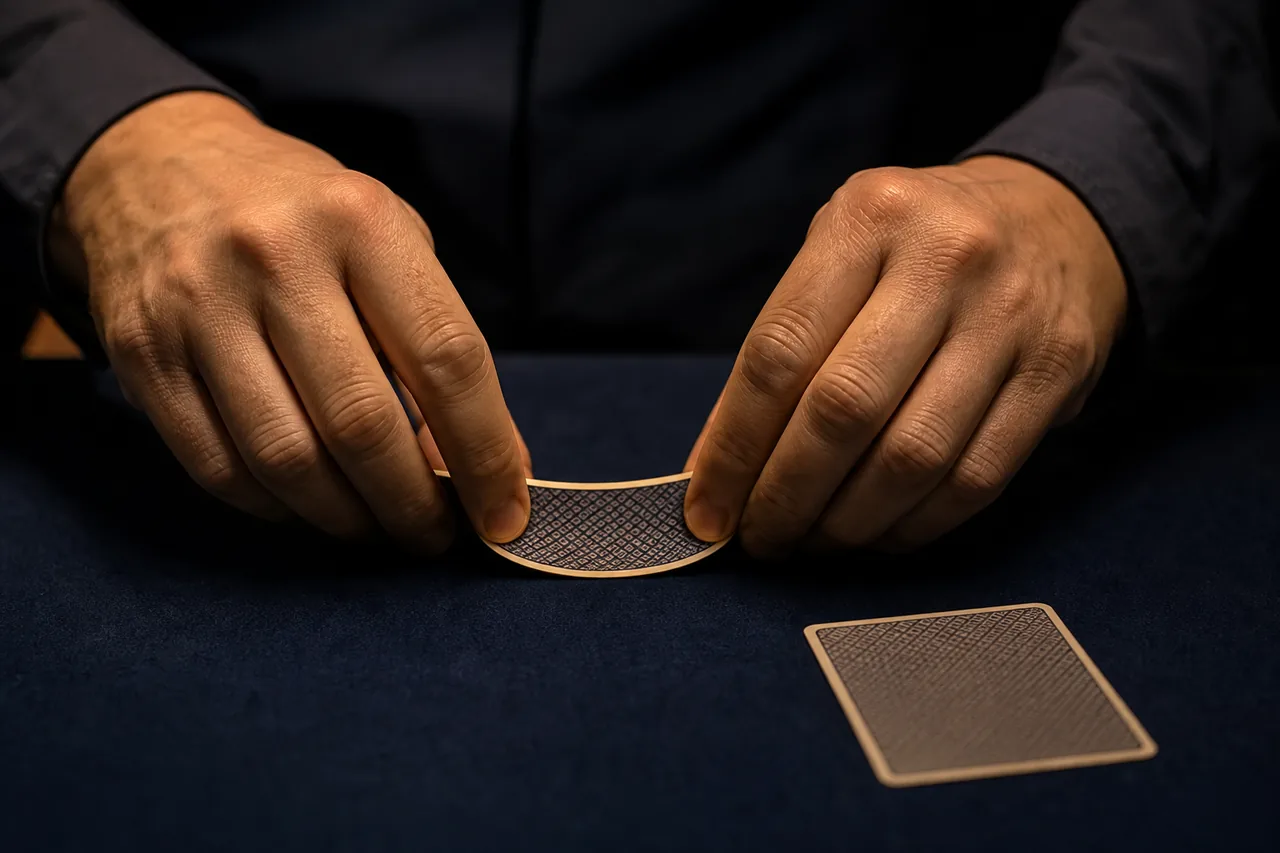
A live presentation in which the dealer bends some cards and reveals them slowly, edge by edge. It is a show for the camera: the card is fixed once it leaves the shoe, so the squeeze does not change the odds.
Scorecards and patterns
Live tables and many RNG games show the results of the current shoe as scorecards, often called roads. They record what has happened. They do not tell you what comes next.
- Bead plate
Every hand in order, one circle per hand, filled top to bottom and then left to right: red for Banker, blue for Player, green for a tie.
- Big road
Repeats are grouped in columns, and a new column starts each time the result switches between Banker and Player. Ties are marked with a slash on the last circle. A run that reaches the bottom turns right.
- Derived roads
Big eye boy, small road and cockroach pig are drawn from the big road. Their colours show whether the big road is repeating or alternating, not whether Banker or Player came up.
- The shoe has no memory
Wizard of Odds calls baccarat, for all intents and purposes, a game of independent trials; removing dealt cards shifts the odds of the next hand only very slightly. A long run of Banker does not make Player due.
One shoe on a scorecard
- 0 hands
- 0 Banker
- 0 Player
- 0 Tie
- 0 longest run
- Banker
- Player
- Tie (slash on the big road)
Each press deals a complete eight-deck shoe, about 80 hands, with the same rules as the deal at the top of the page. Runs of five or six of the same result are normal: in 20,000 simulated shoes, 92% had a run of five or more Banker or Player results in a row and 69% a run of six or more. Before every hand the chances stay at about 45.9% Banker, 44.6% Player and 9.5% Tie.
What the games look like
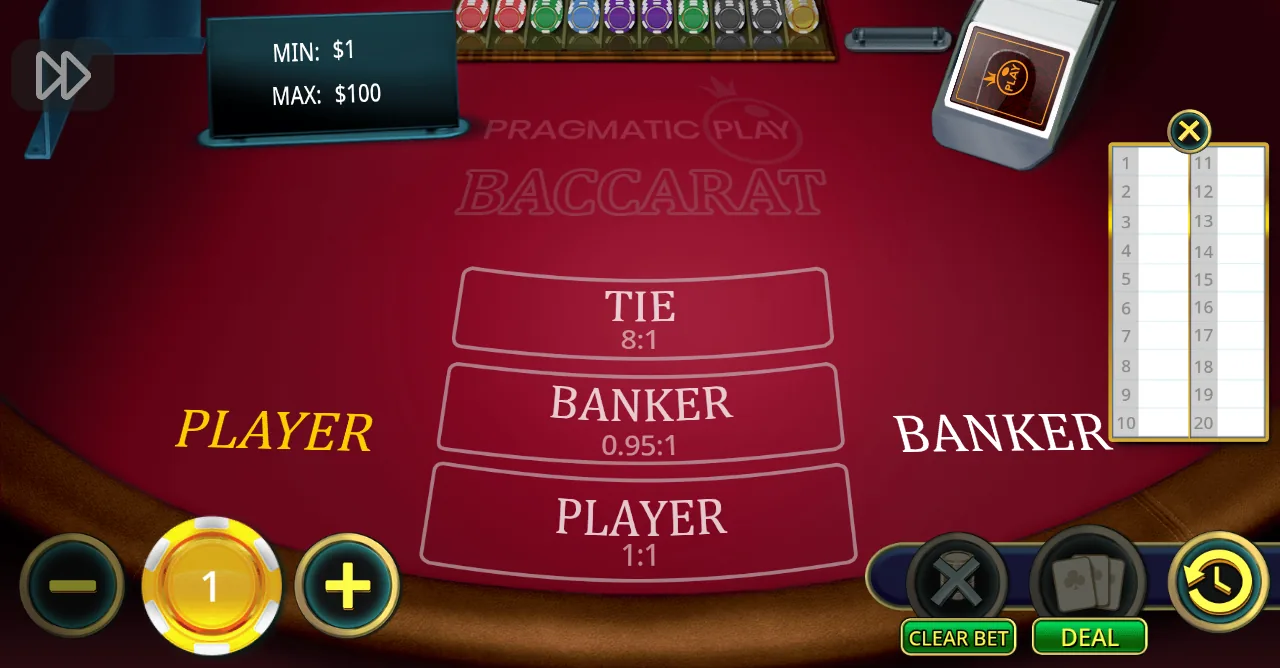
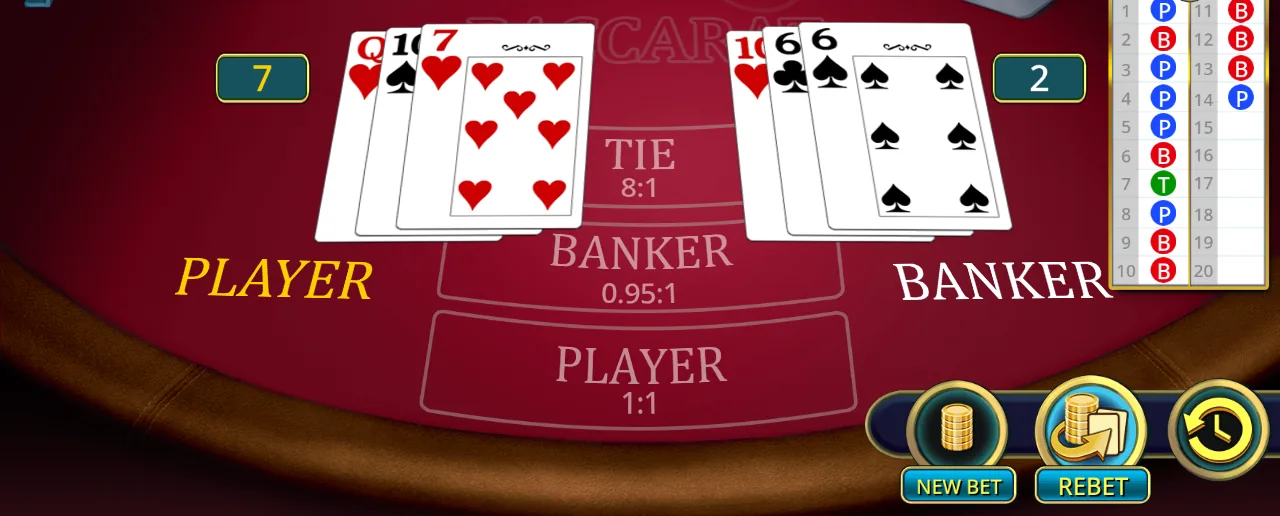
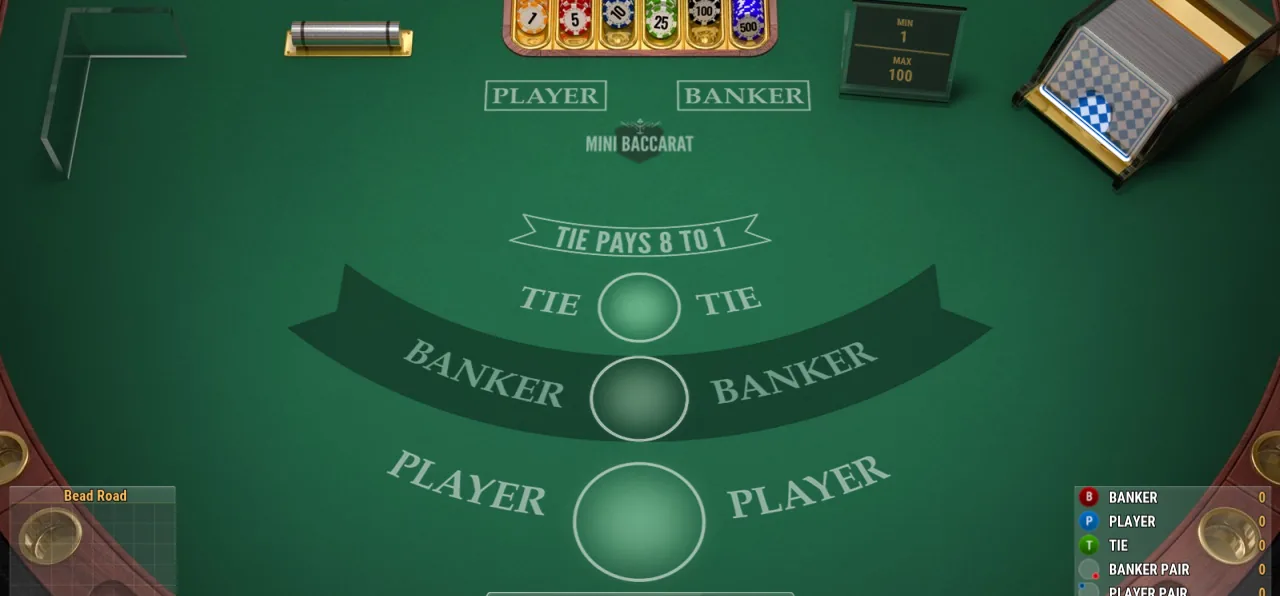
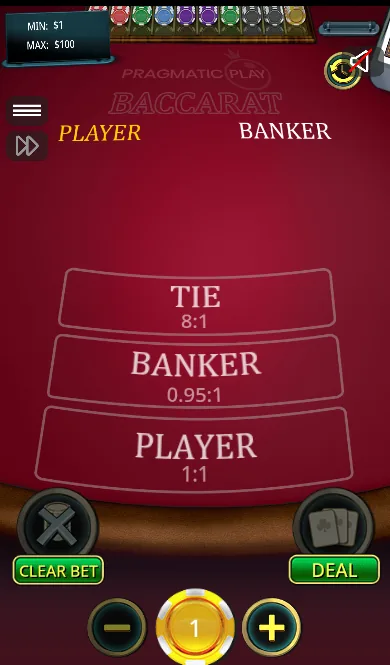
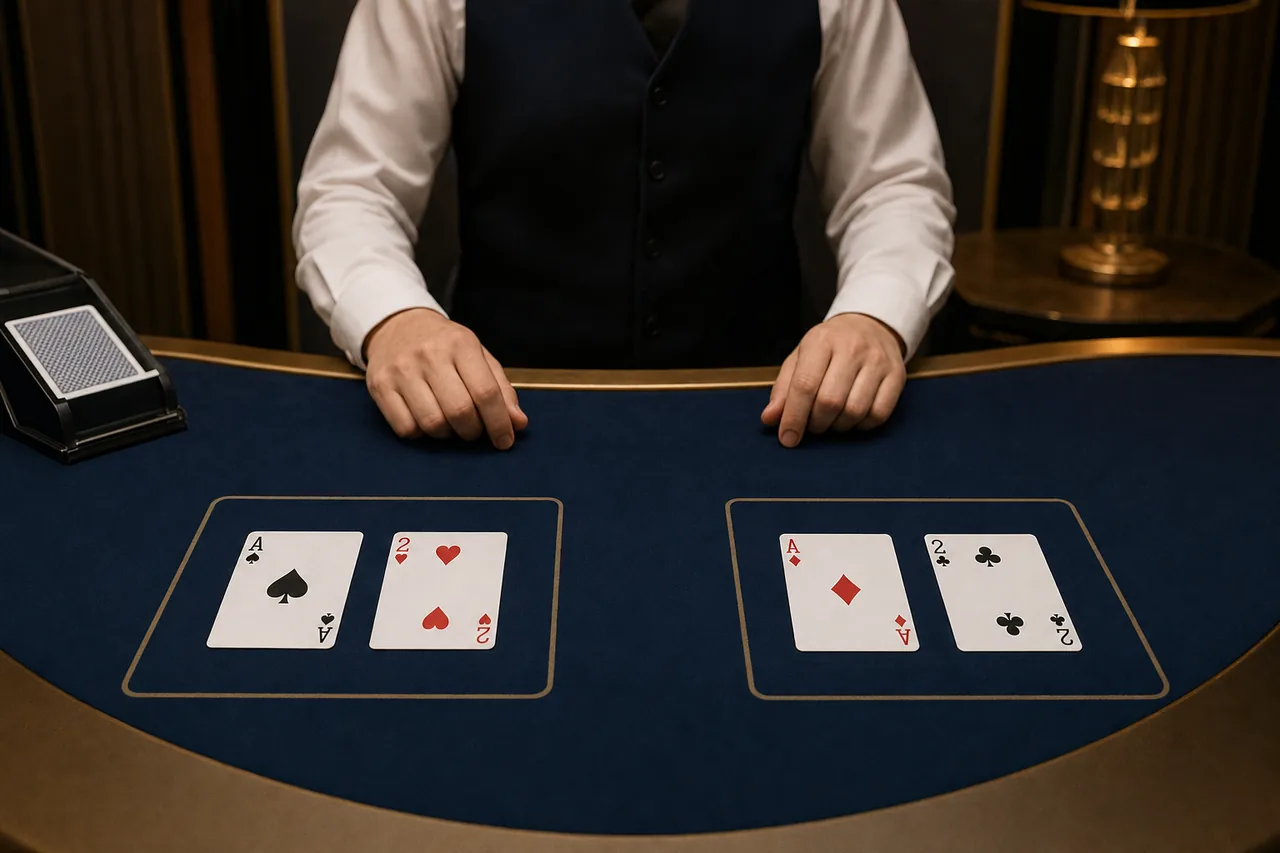
Screenshots from the free demo versions on the studios’ own websites, taken on 13 October 2026. The play-money status bar of each game has been cropped off. Live baccarat has no play-money version, so the two pictures of live tables further down are AI-generated illustrations of typical tables.
Is online baccarat legal in Canada?
It depends on your province. Under the Criminal Code only a provincial government can conduct and manage online gambling, so each province decides who may offer casino games such as baccarat. Ontario has run an open market of registered private operators since 4 April 2022, and Alberta opened its own on 13 July 2026. Most other provinces offer online casino games through a single Crown platform, and the territories have no online casino platform. Our guide Are online casinos legal in Canada? covers each province, its regulator and its minimum age.
Frequently asked questions
Play within your limits
Baccarat is a game of chance and the house edge applies to every hand. Set a time and money limit before you start and treat any spend as the cost of entertainment. 19+ (18+ in Alberta, Manitoba and Quebec). Free, confidential help: ConnexOntario 1-866-531-2600, and every province’s helpline is on our responsible gambling page.