Online Craps in Canada
Craps looks busy, but every round follows the same rhythm: a come-out roll, then a point that has to come again before a 7. This guide shows how a round works, how likely each total is and what every bet on the layout pays and costs.
- Come-out roll
- Point phase
- Decided
Point: none yet
Total 7
Press the button to roll two dice. Each roll is explained from the side of a pass line bet: what it settles and what happens next.
Illustration only: two random dice, every face equally likely. No bets, no money and no balance. The dice have no memory: each roll is independent of the ones before.
- 36 ways two dice can land; six of them make a 7
- 1.41% house edge on the pass line, one of the lowest in the casino
- 16.67% house edge on any seven, the costliest standard bet
What online craps is
Craps is played with two six-sided dice. You bet on the total of the next roll or on a sequence of rolls, and each round follows a fixed rhythm: a come-out roll and, if that does not decide it, a point phase that ends with the point or a 7. Online, the dice are either produced by a random number generator (RNG) or rolled for real in a studio and streamed. The rules and the payouts are the same in both.
- 1
The dice
Two dice give 36 equally likely combinations. Totals in the middle come up most often: a 7 can be made six ways, a 2 or a 12 only one way each. Every payout on the table is set against those counts.
- 2
The come-out roll
The first roll of a round. A 7 or 11 is a natural and settles pass line bets in their favour; a 2, 3 or 12 is craps and settles them against. Any other total (4, 5, 6, 8, 9 or 10) becomes the point.
- 3
The point
Once a point is set, the round runs until that number is rolled again (point made) or a 7 comes first (seven-out). Rolls in between settle only the bets they affect. Then a new come-out roll starts the next round.
Dice odds: how often each total comes up
Click or tap a total to see its combinations, how often it comes up and what it does on the come-out roll, in the point phase and for one-roll bets. The grid shows all 36 ways two dice can land, with the matching ones lit up.
- 7: natural on the come-out, seven-out after a point
- Point numbers 4, 5, 6, 8, 9, 10
- Craps: 2, 3, 12
- 11: natural on the come-out
A total of 7
6 in 36 16.67% per roll, about 1 roll in 6
6 combinations: 1 + 6, 2 + 5, 3 + 4, 4 + 3, 5 + 2, 6 + 1.
- On the come-out roll Natural. Pass line bets are paid and don’t pass bets lose.
- After a point is set Seven-out: ends the round. Pass line bets, come bets already on a number and place bets lose; a new come bet is paid.
- One-roll bets Any seven 4 to 1. The field and every hardway bet lose.
The counts never change: a total that has not come up for a while is no more likely on the next roll. The 7 is the most common total, which is why it ends the point phase and why a bet on the point is always less likely to be paid than not.
How a round works
RNG and live tables follow the same five steps. The difference is who starts each roll: you press roll at an RNG table, while a live table runs on a timer.
Choose a table and a budget
Check the table limits and the field payouts in the help screen, and decide in advance how much you are prepared to spend. Pass line or don’t pass bets go down before the first roll of a round.
The come-out roll
A 7 or 11 pays the pass line and a 2, 3 or 12 loses it; don’t pass works the other way round, with a tie on 12 at most tables. Any other total becomes the point.
The point is marked
A round marker, the puck, turns from OFF to ON and sits on the point number. Come and place bets can now be added, and odds can be added behind a line bet.
The dice keep rolling
Only the point or a 7 settles the pass line. Other totals settle the bets they belong to: one-roll bets on every roll, place and hardway bets when their number or a 7 comes up.
Point made or seven-out
The point before a 7 pays the pass line; a 7 first is a seven-out and ends the round. The puck turns OFF and the next roll is a new come-out. Earlier rounds have no effect on the next one.
Bet explorer: what each bet pays and costs
Every box on this simplified layout is a button. Pick one to see when the bet is decided, what it pays, the house edge per bet resolved and the average cost per C$100 bet. The dots show the edge at a glance. It is a calculator for the published rules: no money and no game involved.
- No edge (odds, only with a line bet)
- Under 2%
- 2% to 10%
- Over 10%
Pass line
A bet with the shooter, placed before the come-out roll. A 7 or 11 on the come-out pays it and a 2, 3 or 12 loses it. Any other total becomes the point, and the bet then needs that point again before a 7.
The bet most rounds are built around, with one of the lowest edges in the casino. Once a point is set, a pass line bet stays on the table until it is decided.
Why craps looks complicated, and the few bets that matter
A craps layout can look like a spreadsheet: dozens of boxes, payouts printed everywhere, and bets that last one roll next to bets that last ten. Most of it is optional. A round is built around a handful of bets with low edges, while the boxes in the middle of the table carry the highest edges in the game.
- Many bets, one pair of dice
Every bet is decided by the same 36 combinations. The layout simply offers many ways to bet on them, each with its own payout and its own gap to the true odds.
- Two speeds at once
Multi-roll bets (pass, come, place, hardways) can stay up for several rolls; one-roll bets (field, any seven, any craps, horn) are settled on the next roll. Both run side by side, which is what makes a table look busy.
- The core bets
Pass line, don’t pass, come and don’t come carry edges of about 1.4%, and place 6 and 8 are close behind at 1.52%. The puck, the point and the rhythm of the round all exist for the line bets.
- The centre of the table
The proposition bets in the middle pay ratios such as 30 to 1, but any craps, the horn and any seven carry edges from 11.11% to 16.67%, and the hardways 9.09% to 11.11%.
| Bet | Pays | House edge per bet resolved | Average cost per C$100 | Decided |
|---|---|---|---|---|
| Pass line, come | 1 to 1 | 1.41% | C$1.41 | Come-out roll, or point or 7 |
| Don’t pass, don’t come | 1 to 1, 12 ties | 1.40% (1.36% per bet made) | C$1.40 | Come-out roll, or 7 or point |
| Odds behind a line bet | 2 to 1 (4, 10), 3 to 2 (5, 9), 6 to 5 (6, 8) | 0% on the odds part only | C$0.00 | With the line bet it backs |
| Place 6 or 8 | 7 to 6 | 1.52% | C$1.52 | Its number or 7 |
| Place 5 or 9 | 7 to 5 | 4.00% | C$4.00 | Its number or 7 |
| Place 4 or 10 | 9 to 5 | 6.67% | C$6.67 | Its number or 7 |
| Field, 2 to 1 on 2 and 12 | 1 to 1, 2 to 1 | 5.56% | C$5.56 | Next roll |
| Field, 3 to 1 on 12 | 1 to 1, 2 to 1, 3 to 1 | 2.78% | C$2.78 | Next roll |
| Big 6 or Big 8 | 1 to 1 | 9.09% | C$9.09 | Its number or 7 |
| Hard 6 or 8 | 9 to 1 | 9.09% | C$9.09 | Its number or 7 |
| Hard 4 or 10 | 7 to 1 | 11.11% | C$11.11 | Its number or 7 |
| Any craps (2, 3, 12) | 7 to 1 | 11.11% | C$11.11 | Next roll |
| Horn (2, 3, 11, 12) | 30 to 1 (2, 12), 15 to 1 (3, 11) on one quarter | 12.50% | C$12.50 | Next roll |
| Any seven | 4 to 1 | 16.67% | C$16.67 | Next roll |
House edge per bet resolved, so ties are not counted, from the Wizard of Odds craps house edge tables (read 13 October 2026). The horn figure is the average of its four parts (13.89% on 2 and 12, 11.11% on 3 and 11). The average cost is a long-run figure, not a prediction for any session.
What the house edge means over many bets
- Pass line or come 1.41% house edge C$1.41
- Place 6 or 8 1.52% house edge C$1.52
- Field, 2 to 1 on 2 and 12 5.56% house edge C$5.56
- Hard 6 or 8 9.09% house edge C$9.09
- Horn 12.50% house edge C$12.50
- Any seven 16.67% house edge C$16.67
The figure is the long-run average the game keeps from the total amount bet. It is not a prediction: a single session can end well above or well below it. Money that is bet again counts towards the total every time it is bet.
RNG or live craps
- RNG craps
A random number generator produces both dice for every roll and an animation shows them landing. You roll when you are ready, so rounds are quick. Examples are Play’n GO’s GO Craps and Evolution’s First Person Craps, an RNG game modelled on its live studio.
- Live craps
Real dice are rolled at a studio table and streamed, and you bet on a digital layout over the video. Rolls run on a timer. Evolution’s Live Craps, set in a speakeasy-style studio, is one example.
- Same math in both
The house edge comes from the payouts, not the format: a pass line bet carries 1.41% at an RNG table and at a live table alike. Field payouts are the one rule that often differs, so check the help screen.
- No dice control online
Some land-based players believe a practised throw can influence the dice. Online there is no throw to control: the RNG decides RNG rolls and the studio rolls the live dice. No betting pattern, and no “hot” or “cold” streak, changes the next roll.
What the games look like
Screenshots from the free demo versions on the studios’ own websites, taken on 13 October 2026. The play-money balance, the bet totals and the chip selector have been cropped off.
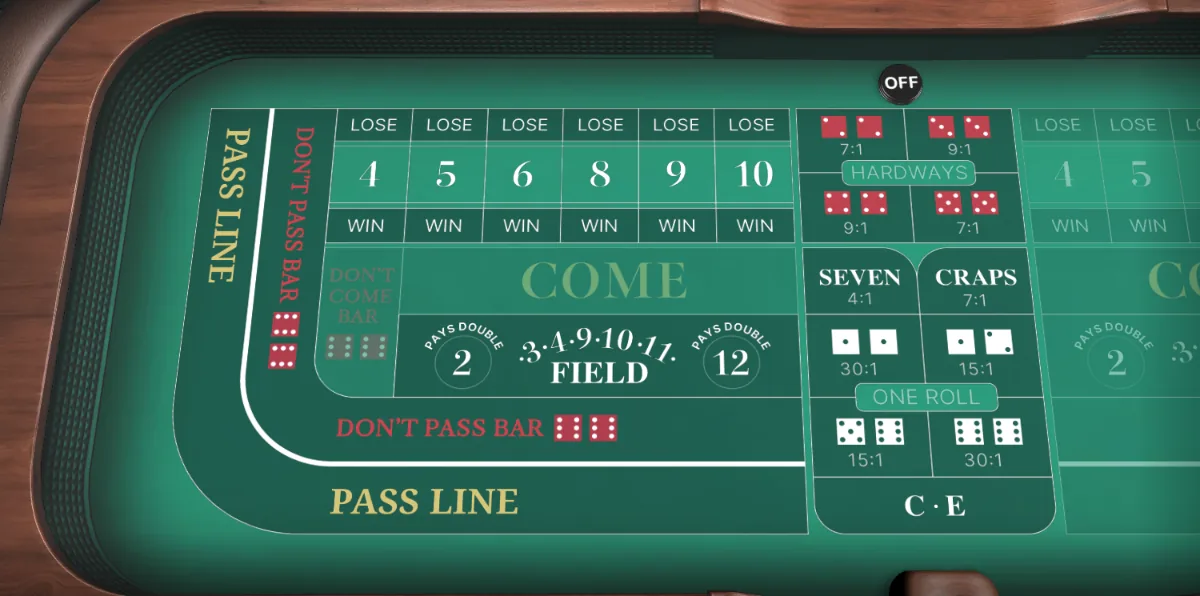
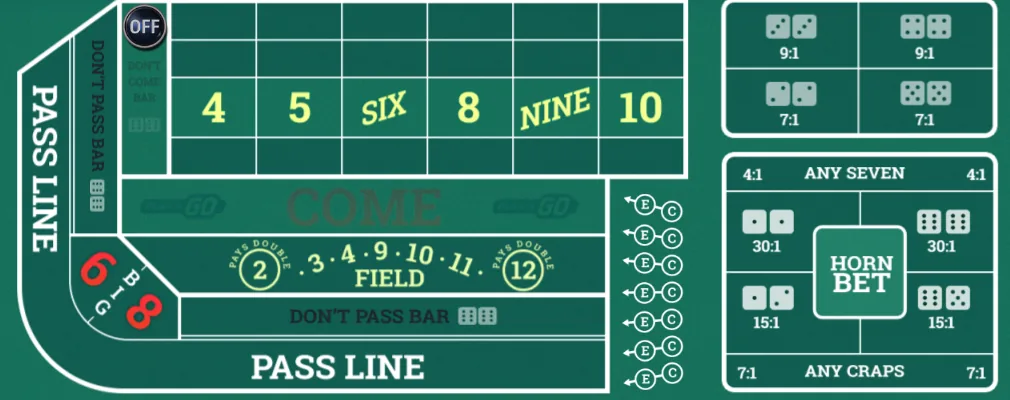
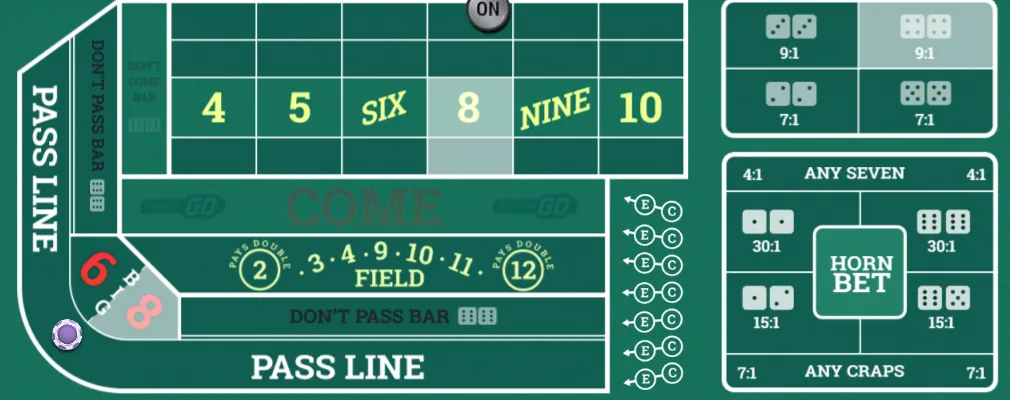
Live craps tables
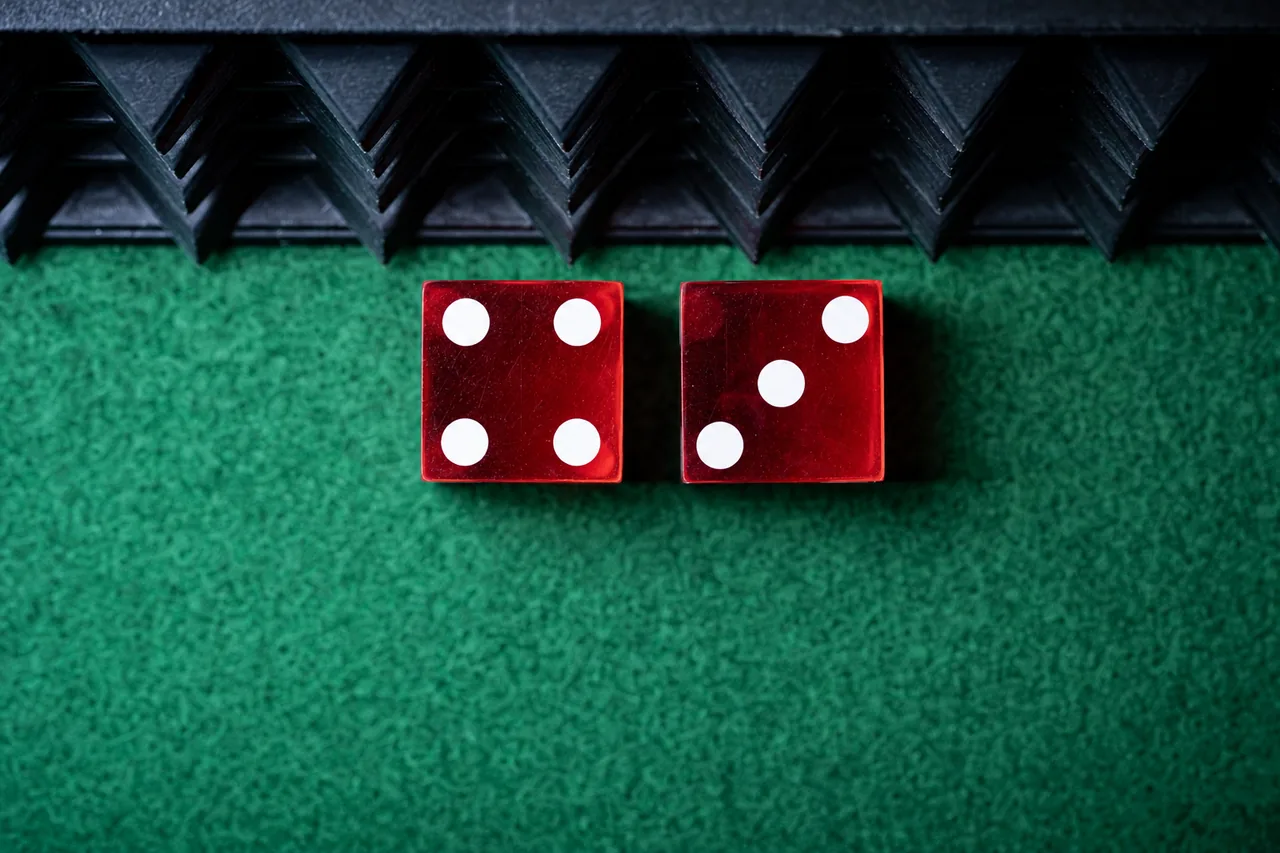
Live craps has no play-money version, so these are AI-generated illustrations of typical live craps tables. Real studios differ in layout and decor, but the round works the same way.


Is online craps legal in Canada?
It depends on your province. Under the Criminal Code only a provincial government can conduct and manage online gambling, so each province decides who may offer casino games such as craps. Ontario has run an open market of registered private operators since 4 April 2022, and Alberta opened its own on 13 July 2026. Most other provinces offer online casino games through a single Crown platform, and the territories have no online casino platform. Our guide Are online casinos legal in Canada? covers each province, its regulator and its minimum age.
Frequently asked questions
Play within your limits
Craps is a game of chance and the house edge applies to every bet and every roll. Set a time and money limit before you start and treat any spend as the cost of entertainment. 19+ (18+ in Alberta, Manitoba and Quebec). Free, confidential help: ConnexOntario 1-866-531-2600, and every province’s helpline is on our responsible gambling page.