Crash Games in Canada
How a crash round works, where the crash point comes from and why every cash-out target carries the same house edge. Run the illustration to see random crash points from a 97% RTP model, then try the target and streak explorers below.
Press the button to run one round: a short betting window, then the multiplier rises until the crash point.
Illustration only: crash points are drawn at random from the standard model for a 97% RTP game, where the chance of reaching x or more is 0.97 ÷ x and 3 rounds in 100 crash instantly. No bets, no money and no balance.
- 97% RTP Spribe states for Aviator: a 3% house edge on every bet
- 1.94x half of all rounds end below this point in the standard 97% RTP crash model
- 3% of rounds crash instantly at 1.00x in the same model
What crash games are
A crash game is a short round built around one number. A multiplier starts at 1.00x and rises, usually drawn as a curve with a plane, jet or rocket on top, and at a random point it stops: the crash. Every bet in the round is settled against that single crash point. Aviator by Spribe, Spaceman by Pragmatic Play and JetX by SmartSoft Gaming are three of the best-known titles.
- 1
The multiplier
The multiplier grows from 1.00x for as long as the round lasts. It can stop after a fraction of a second or run past 100x; the game’s random number generator sets the crash point before the round starts.
- 2
The cash-out
A bet that is cashed out while the multiplier is still rising is paid at the multiplier shown at that moment, for example 2.00 times the stake at 2.00x. You can press the button or set an automatic cash-out multiplier in advance.
- 3
The crash
A bet still open when the multiplier crashes is lost. The payout table is built so that, over many rounds, the game returns its RTP whatever multiplier you aim for. The difference to 100% is the house edge.
How a round works
Crash games run as shared rounds on a fixed cycle: everyone at the game sees the same curve and the same crash point. Most titles follow these five steps.
Betting window
Between rounds a short countdown runs. Bets are placed during this window and can usually be cancelled until it closes. Decide in advance how much you are prepared to spend in a session.
One or two bets per round
Many crash games show two bet panels, so two separate bets can run in the same round, each with its own cash-out. SmartSoft lists up to four for JetX. Each bet carries the same house edge, so two bets mean twice the amount staked.
The multiplier rises
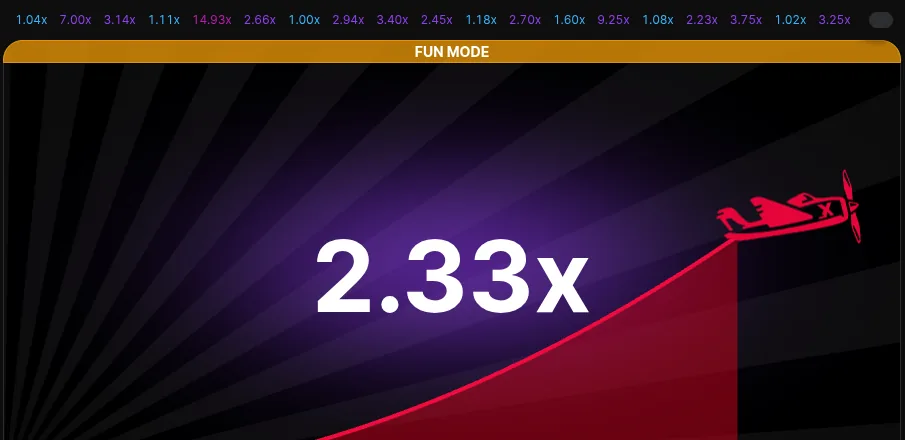
The round starts at 1.00x and the multiplier climbs, slowly at first and then faster. While it rises, an open bet can be cashed out at the current value, by hand or by an automatic cash-out set before the round.
The crash
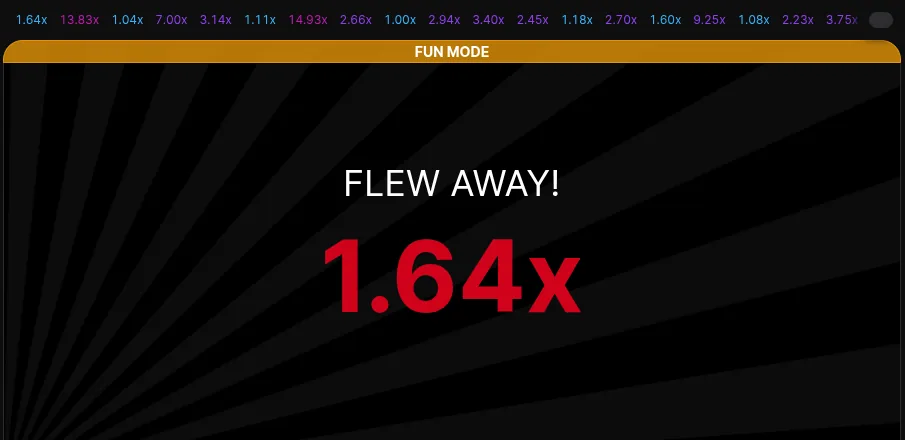
At the crash point the curve stops and the game shows the final multiplier, for example “flew away” in Aviator. Bets still open at that moment are lost. Some rounds crash at 1.00x before the multiplier moves at all.
The next round
The crash point is added to the history strip and a new betting window opens within seconds. Each round has its own crash point, independent of the ones before.
Target explorer: the same edge for every target
Pick an RTP and a cash-out target between 1.10x and 100x. A low target is reached in most rounds but pays little; a high target pays a lot but is reached rarely. In the standard crash model the two balance out exactly, so the long-run return is the RTP whatever you pick. The simulation draws 1,000 rounds in your browser to show how far a single sample can stray from that average.
0.97 ÷ 2.00 = 48.50% chance per round. 48.50% × 2.00 = 97% returned on average, the same for every target.
1,000 simulated rounds
- Return so far in this sample
- Long-run RTP
Press the button to draw 1,000 random crash points from the model and apply the target above to every round.
A calculator for the standard crash model, not a game: no bets and no balance. The return is the share of the total amount staked that comes back over many rounds. Real games round their crash points and set a maximum payout, which can move the figures slightly; the game’s help screen states its own RTP.
What the house edge costs over a session
- 97% RTP game, target 1.50x reached in 64.67% of rounds C$3.00
- 97% RTP game, target 2x reached in 48.50% of rounds C$3.00
- 97% RTP game, target 10x reached in 9.70% of rounds C$3.00
- 97% RTP game, target 100x reached in 0.97% of rounds C$3.00
- 95% RTP game, any target 5% house edge C$5.00
The figure is the long-run average the game keeps from the total amount bet. It is not a prediction: a single session can end well above or well below it, and the higher the target, the wider the swings. Money that is bet again counts towards the total every time it is bet.
Streak explorer: how swingy high targets are
The same average hides very different sessions. Pick a target and a number of rounds to see how likely it is that every one of them ends below the target. High targets come with long runs where nothing is reached; nothing in the game makes the next round more likely to reach them after a long run.
Chance that every round ends below 10x
- 5 rounds 60.0%
- 10 rounds 36.0%
- 20 rounds 13.0%
- 50 rounds 0.61%
- 100 rounds < 0.01%
Exact figures for the 97% RTP model: the chance that n rounds in a row all end below target x is (1 − 0.97 ÷ x) to the power n. A long run below the target changes nothing about the next round.
The RNG, the history strip and the multiplayer view
- The crash point is set first
A random number generator fixes each round’s crash point before the round starts; Aviator’s rules say so in as many words. When to cash out is your decision, but it cannot move the crash point.
- The history strip has no memory
The row of recent crash points at the top of the game only shows the past. A run of low results does not make a high one “due”, and apps or sites that say they can predict the next crash point cannot know a value the game’s RNG has not shown yet.
- Other players do not change your round
The live bets panel, chat and leaderboards show what other people at the game are doing. Everyone shares the same crash point, and their bets and cash-outs have no effect on when it comes.
Do betting systems work in crash games?
No. Systems such as the Martingale (double the stake after every round that ends below the target) or fixed cash-out patterns change how much is staked, not the chance of any round. Every bet in a 97% RTP game carries the same 3% edge, so a series of bets carries it on the whole amount. The table shows how quickly doubling grows the stake at a 2x target, and how often the long runs that break it come up.
| Rounds in a row below 2x | Chance of that run (97% RTP) | Staked so far | Next stake when doubling |
|---|---|---|---|
| 3 | 13.66%, about 1 run in 7 | 7 units | 8 units |
| 5 | 3.62%, about 1 run in 28 | 31 units | 32 units |
| 7 | 0.96%, about 1 run in 104 | 127 units | 128 units |
| 10 | 0.13%, about 1 run in 762 | 1,023 units | 1,024 units |
A unit is the first stake of the sequence. The chance that a 2x target is missed is 1 − 0.97 ÷ 2 = 51.5% per round. The game’s maximum bet can stop the doubling before the bigger rows, and the edge applies to every unit staked along the way.
Three well-known crash games
The figures below come from each studio’s own website or from the game’s rules screen. Lobbies in Canada may carry other versions, so the help screen of the game you open is the figure that counts.
| Aviator | Spaceman | JetX | |
|---|---|---|---|
| Studio | Spribe | Pragmatic Play | SmartSoft Gaming |
| Theme | A propeller plane on a rising curve | An astronaut flying through space | A jet taking off from a runway |
| RTP stated by the studio | 97% | 95% | Not stated on the studio’s game page |
| Bets per round | See the help screen | See the help screen | Up to four at once (studio page) |
| Cash-out options | Manual and automatic | Manual, automatic and a 50% option that closes half of a bet | Manual and automatic |
Features you will see
Crash games add their own names and themes, but the round underneath is the same rising multiplier. These features change how you place and close bets, not the house edge.
Separate bets in the same round, each with its own stake and cash-out. Both are settled against the one crash point, and the edge applies to each of them.
A multiplier set before the round at which the bet closes by itself. It is a convenience setting: the chance of reaching that multiplier and the RTP stay the same as with a manual cash-out.
Repeats the same bet round after round. Rounds follow each other quickly, so the amount staked adds up fast; a loss limit or a set number of rounds keeps it in check.
Some games, such as Spaceman with its 50% option, close part of a bet and leave the rest open. Each part is simply a bet with its own target, so the long-run return does not change.
Panels with other players’ bets, chat, leaderboards and the history strip. They are social features and records of the past; they do not influence the next round.
What the games look like
Screenshots from the free demo of Aviator on Spribe’s own website, taken on 13 October 2026. The play-money balance, the bet panels and the live bets panel have been cropped off. Spaceman and JetX are not shown here.
Where crash games are available in Canada
Availability follows the provincial rules. In Ontario, game studios supplying registered operators must themselves be registered with the AGCO, and Spribe is registered with the AGCO as a gaming-related supplier. In Alberta, studios need their own AGLC registration as well: Pragmatic Play is registered with AGLC; Spribe (Aviator) and SmartSoft (JetX) were not on AGLC’s registrant list on 28 October 2026. Crown platforms in the other provinces choose their own game lobbies, so check the platform’s lobby. Crash games are also common on offshore sites, which no provincial regulator licenses.
Is it legal to play crash games online in Canada?
It depends on your province. Under the Criminal Code only a provincial government can conduct and manage online gambling, so each province decides who may offer casino games such as crash games. Ontario has run an open market of registered private operators since 4 April 2022, and Alberta opened its own on 13 July 2026. Most other provinces offer online casino games through a single Crown platform, and the territories have no online casino platform. Our guide Are online casinos legal in Canada? covers each province, its regulator and its minimum age.
Frequently asked questions
Play within your limits
Crash games are games of chance with short rounds that follow each other quickly, and the house edge applies to every bet. Set a time and money limit before you start and treat any spend as the cost of entertainment. 19+ (18+ in Alberta, Manitoba and Quebec). Free, confidential help: ConnexOntario 1-866-531-2600, and every province’s helpline is on our responsible gambling page.