Online Keno in Canada
Keno is a number draw: you pick up to 10 numbers on a board of 80, then 20 numbers are drawn. This guide shows the exact odds for every spot count, what lottery and online paytables return, and why no way of choosing numbers changes the result.
Pick 1 to 10 numbers on the board, or use quick pick.
Illustration only: 20 random numbers from 1 to 80, drawn in your browser. No stakes, no money and no payouts. Each draw is independent of the one before.
- 20 numbers drawn from a board of 80 in every game on this page
- 25% chance that any single number you pick is among the 20 drawn
- 62% highest return on Western Canada’s lottery KENO prize table, against about 91% for online keno
What online keno is
Keno is a lottery-style draw game. You choose a few numbers on a board, a draw picks 20 numbers at random, and the paytable decides what a ticket pays for the number of matches. Provincial lotteries sell keno at retail counters, and online casinos offer it as a random number generator (RNG) game that draws the moment you press play.
- 1
The board
The board holds the numbers 1 to 80 in eight rows of ten. Each number you mark is a spot. Lottery keno in Western Canada takes 1 to 10 spots; the Play’n GO online game takes 2 to 10.
- 2
The draw
20 of the 80 numbers are drawn. A spot that is drawn is a catch. A quarter of the board is drawn, so each spot has a 1 in 4 chance and, on average, a quarter of your spots are caught: 2.5 out of 10.
- 3
The paytable
Every spot count has its own row of payouts for each number of catches. The payouts are set below what the odds would justify, and that gap is the house edge. It differs a lot from one paytable to the next.
How a keno draw works
Lottery keno and online keno follow the same five steps. The main difference is the clock: lottery keno draws on a fixed schedule, while an online RNG game draws as soon as you start the round.
Check the paytable and set a budget
Look at the paytable row for the number of spots you plan to use, and decide in advance how much you are prepared to spend.
Pick your spots
Mark your numbers on the board or use quick pick (called autopick in some games), which picks random numbers for you. Both have exactly the same chance.
Set the stake and the number of draws
Western Canada’s lottery KENO takes $1, $2, $5 or $10 per draw and can repeat the same numbers for up to 99 draws in a row. An online game sets the stake per round in the game itself.
20 numbers are drawn
Lottery KENO in Western Canada draws every five minutes through most of the day. An online game draws its 20 numbers with a random number generator as soon as you press play.
Catches are counted and paid
The paytable row for your spot count decides the payout for the number of catches. Many results pay nothing. The next draw starts from scratch: earlier draws have no effect on it.
Odds explorer: what to expect from each spot count
Pick a spot count to see the exact chance of each result in one draw. The figures come from counting combinations: there are 3,535,316,142,212,174,320 ways to draw 20 numbers from 80, and each row counts the share of them that contains exactly that many of your spots.
| Catches | Chance | Odds | |
|---|---|---|---|
| 5 | 0.06% | 1 in 1,551 | |
| 4 | 1.21% | 1 in 82.7 | |
| 3 | 8.39% | 1 in 11.9 | |
| 2 | 27.05% | 1 in 3.70 | |
| 1 | 40.57% | 1 in 2.46 | |
| 0 | 22.72% | 1 in 4.40 |
Chances with 5 spots
Catching every spot gets much harder with each spot you add: 1 in 4 with one spot, about 1 in 1,551 with five and about 1 in 8.9 million with ten. The odds are the same in every 80-number game; only the payouts differ.
Paytables: why keno returns 50% in one game and 92% in another
A keno paytable lists, for each spot count, what a ticket pays for 1 unit staked at each number of catches. Multiply every payout by its chance and add the results, and you get the return to player (RTP). Pick a paytable and a spot count to see the return, the house edge and how each row adds to it.
| Catches | Pays for 1 | Chance | Adds to return |
|---|---|---|---|
| 6 | 1,500 | 0.01% | 19.35% |
| 5 | 50 | 0.31% | 15.48% |
| 4 | 5 | 2.85% | 14.27% |
| 3 | 1 | 12.98% | 12.98% |
| 2 | 0 | 30.83% | 0% |
| 1 | 0 | 36.35% | 0% |
| 0 | 0 | 16.66% | 0% |
Source: Western Canada Lottery Corporation, KENO prize table (prize for each $1 wagered), read on 13 October 2026. Sold at lottery retailers in Alberta, Saskatchewan, Manitoba and the territories.
WCLC KENO, 6 spots
- 1 spot 50.00%
- 2 spots 60.13%
- 3 spots 55.50%
- 4 spots 58.20%
- 5 spots 60.72%
- 6 spots 62.08%
- 7 spots 60.42%
- 8 spots 57.20%
- 9 spots 60.54%
- 10 spots 59.65%
A lottery keno paytable. Across the ten spot counts the return stays between 50.00% and 62.08%: the lottery keeps 38 to 50 cents of every dollar played in the long run.
What the house edge means over many draws
- European roulette, for comparison 2.70% house edge C$2.70
- Play’n GO Keno, 2 spots 7.91% house edge, the lowest on its paytable C$7.91
- Play’n GO Keno, 4 spots 9.17% house edge, the highest on its paytable C$9.17
- WCLC KENO, 6 spots 37.92% house edge, the lowest on its prize table C$37.92
- WCLC KENO, 1 spot 50.00% house edge, the highest on its prize table C$50.00
The figure is the long-run average the game keeps from the total amount played. It is not a prediction: a single session can end well above or well below it. Money that is played again counts towards the total every time it is staked.
Hot numbers, cold numbers and quick pick
Number systems are popular in keno, but none of them changes the odds, because the draw does not know which numbers anyone picked or what happened before.
- Every draw starts fresh
The 20 numbers are drawn with no memory of earlier draws. A number that has not come up for 50 draws is no more likely next time. Western Canada Lottery Corporation’s KENO page says personal strategies, superstitions or lucky rituals have no impact on the outcome.
- Hot and cold panels show history
Some games and lottery sites show which numbers came up most or least often recently. That is a record of the past, not a forecast: every number keeps its 1 in 4 chance in every draw.
- Quick pick has the same chance
Numbers chosen at random by quick pick and numbers you choose yourself are caught exactly as often. Birthdays, patterns on the board or a favourite row change nothing either.
- More draws do not improve the odds
Playing more draws, or the same numbers for longer, does not make a catch more likely. Each draw costs the stake again and carries the same house edge.
Provincial lottery keno vs online casino keno
The draw is the same, but who runs the game, how often it draws and above all the paytable are not. The table compares Western Canada’s lottery KENO with Play’n GO’s online keno, the two paytables used in the calculator above.
| Lottery keno (WCLC KENO) | Online casino keno (Play’n GO Keno) | |
|---|---|---|
| Run by | Western Canada Lottery Corporation, for Alberta, Saskatchewan, Manitoba and the territories | A game studio that supplies online casinos |
| Where | Lottery retailers | Online, on a computer or phone |
| Board and draw | 80 numbers, 20 drawn | 80 numbers, 20 drawn |
| Spots | 1 to 10 | 2 to 10 |
| When it draws | Every five minutes, on a fixed schedule | As soon as you press play |
| Stake | $1, $2, $5 or $10 per draw, up to 99 consecutive draws | Set in the game for each round |
| Return to player | 50.00% to 62.08%, by spot count | 90.83% to 92.09%, by spot count |
| Largest payout | $100,000 for 10 of 10 on a $1 ticket, also the cap per ticket per draw | 10,000 for 1 for 10 of 10 |
Returns are calculated on this page from each paytable and the exact odds. At WCLC, if two or more tickets catch 10 of 10 in the same draw, they share $200,000 and no ticket receives more than $100,000. Other provincial lotteries, such as OLG in Ontario (Daily Keno), sell keno games with their own rules and prize tables.
The main variants
The classic game draws 20 numbers from 80. The variants below change the format or add options, and each one comes with its own paytable and return.
20 numbers drawn from 80 and 1 to 10 spots, as in both games compared on this page. The odds explorer above applies to every game in this format.
The same numbers play for several draws in a row: up to 99 consecutive draws at WCLC KENO. Each draw is staked separately and carries the same edge.
Some lottery and online versions offer an option that multiplies a payout by a randomly drawn factor. It costs extra per draw or comes with lower base payouts, so check the return with the option switched on in the game rules.
Some online games use fewer numbers. In Spribe’s Keno you choose up to 10 numbers out of 36, and the studio states an RTP of 97% for it. The odds on this page apply only to the 80-number game.
Some online keno games add separate bets on the first number drawn, such as odd or even or over or under a line. Each side bet has its own odds and payout, separate from the main ticket.
What the games look like
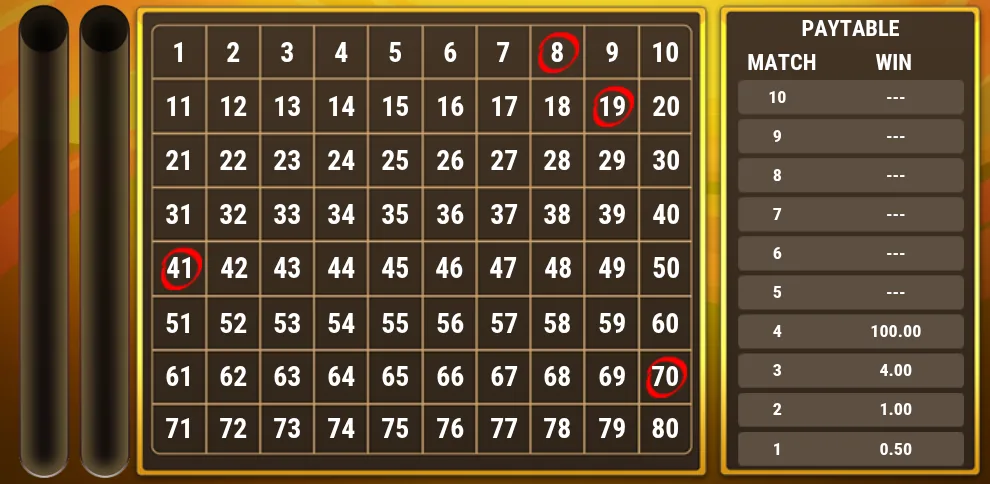
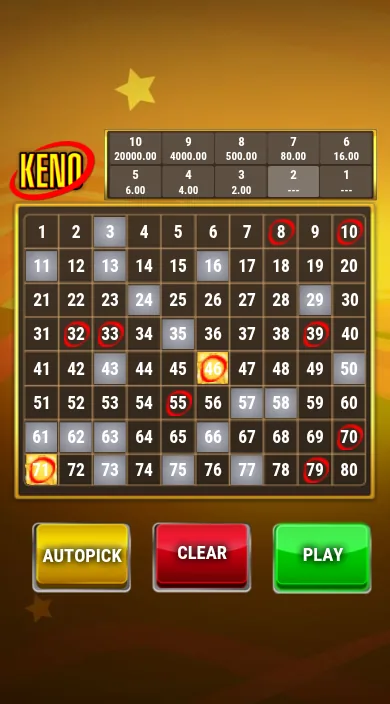
Screenshots from the free demo of Play’n GO Keno on the studio’s own website, taken on 13 October 2026. The play-money status bar with the balance and stake has been cropped off. On desktop the paytable values are shown at a 1.00 stake, so they read as payouts for 1.
Is online keno legal in Canada?
It depends on your province. Under the Criminal Code only a provincial government can conduct and manage online gambling, so each province decides who may offer casino games such as keno. Ontario has run an open market of registered private operators since 4 April 2022, and Alberta opened its own on 13 July 2026. Most other provinces offer online casino games through a single Crown platform, and the territories have no online casino platform. Our guide Are online casinos legal in Canada? covers each province, its regulator and its minimum age.
Frequently asked questions
Play within your limits
Keno is a game of chance and the house edge applies to every draw: about 8% to 9% on the online paytable above and 38% to 50% on lottery keno. No way of choosing numbers changes it. Set a time and money limit before you start and treat any spend as the cost of entertainment. 19+ (18+ in Alberta, Manitoba and Quebec); lottery keno in Ontario is 18+. Free, confidential help: ConnexOntario 1-866-531-2600, and every province’s helpline is on our responsible gambling page.