Online Sic Bo in Canada
Three dice, 216 possible rolls and around fifty places to bet. This guide shows what every sic bo bet covers, what it pays on two common paytables and what the house edge costs. The dice shaker shows how many areas of the layout a single roll touches.
Illustration only: three random dice, each from 1 to 6. No bets, no money and no balance. Every roll is independent of the one before.
- 216 possible rolls of three dice (6 x 6 x 6)
- 2.78% house edge on Small and Big, a 97.22% return to player
- 6 triples among the 216 rolls: Small and Big lose on all of them
What online sic bo is
Sic bo is a dice game of Chinese origin, also known as tai sai or dai siu (“big small”). Three dice are shaken in a closed container and you bet on what they will show: the total, a single number, a pair, a triple or a combination of two numbers. Online, the dice come either from a random number generator (RNG) or from a real shaker streamed from a studio. Each bet pays at fixed odds that the game’s paytable lists.
- 1
The dice
Three standard dice give 6 x 6 x 6 = 216 equally likely rolls. Totals run from 3 to 18, but they are not equally likely: 10 and 11 can each be made in 27 ways, 3 and 18 in only one.
- 2
The layout
The table has Small and Big at the top, then doubles and triples, the totals from 4 to 17, the fifteen two-dice combinations and the single numbers 1 to 6. One roll is covered by many areas at once.
- 3
The paytable
Unlike roulette, sic bo has no single standard. The same bet can pay 8 to 1 at one table and 10 to 1 at another, and the house edge moves with it. Small and Big are the exception: they pay even money almost everywhere.
Bet explorer: every area on the sic bo layout
Click or tap any area of the layout. The panel shows how many of the 216 rolls the bet covers, what it pays and the house edge on two common paytables published by Wizard of Odds: the Atlantic City table and the Macau table. Switch the paytable to see the payouts on the layout change. It is a calculator for published rules: no money and no game involved.
Payouts are shown in yellow on each area. Real games vary: the help screen has the paytable of the game you open.
Big (total 11 to 17)
Covers 105 of the 216 possible rolls (48.61%), about 1 in 2.1.
Pays even money but loses on every triple, including 4-4-4, 5-5-5 and 6-6-6. Those 3 rolls in 216 on each side are the whole house edge.
How the 216 rolls add up
Each bar shows how many of the 216 rolls make that total. Middle totals come up far more often than the edges, which is why a bet on 10 pays 6 to 1 and a bet on 4 pays 50 or 60 to 1. Click or tap a bar for the details.
Totals of three dice, out of 216 rolls
Red marks the triples inside each bar: the rolls on which Small and Big both lose.
- Small: totals 4 to 10
- Big: totals 11 to 17
- Triples: Small and Big lose
105 Small rolls + 105 Big rolls + 6 triples = 216. The six triples, 1 in 36 rolls, sit on neither side.
Total 10
27 of 216 rolls (12.50%), about 1 in 8.
Made by 1-3-6 (6 ways), 1-4-5 (6 ways), 2-2-6 (3 ways), 2-3-5 (6 ways), 2-4-4 (3 ways), 3-3-4 (3 ways).
- Counts for Small
- Atlantic City paytable 6 to 1, edge 12.50%
- Macau paytable 6 to 1, edge 12.50%
Why triples matter for Small and Big
Without the triple rule, Small and Big would be a fair coin toss: 108 rolls total 4 to 10 and 108 total 11 to 17. The rule takes three rolls from each side (1-1-1, 2-2-2 and 3-3-3 from Small; 4-4-4, 5-5-5 and 6-6-6 from Big), leaving 105 of 216. At even money that is a house edge of 6 in 216, or 2.78%, the lowest of the standard bets. Odd and Even, where a game offers them, work the same way.
What the house edge means over many rolls
- Small or Big 2.78% on both paytables C$2.78
- Single number 7.87% on both paytables C$7.87
- Total 7 or 14 9.72%, the lowest of the totals C$9.72
- Any triple, Atlantic City 13.89% at 30 to 1 C$13.89
- Two-dice combination 16.67% at 5 to 1 C$16.67
- Specific double, Macau 33.33% at 8 to 1 C$33.33
- Total 5 or 16, Macau 47.22% at 18 to 1 C$47.22
The figure is the long-run average the game keeps from the total amount bet. It is not a prediction: a single session can end well above or well below it. Money that is bet again counts towards the total every time it is bet.
How a round works
An RNG table and a live table follow the same five steps. The difference is who starts the round: you press the roll button at an RNG table, while a live table runs on a timer.
Choose a table and a budget
Open the help screen to check the paytable and the return to player, note the minimum and maximum bet, and decide in advance how much you are prepared to spend.
Place chips on the layout
Select a chip value and put it on one or more areas: Small or Big, a total, a number, a double, a triple or a two-dice combination. Several bets can be combined in the same round.
Betting closes
At an RNG table the round starts when you press the button. At a live table a countdown runs, then bets close before the shaker starts.
The dice settle
The three dice are shaken and come to rest. Their faces and their total decide the round, and the game lights up every area the roll covers.
Bets are settled
Bets on the lit areas are paid at the odds in the paytable; all other bets are collected. The next round starts from scratch: earlier rolls have no effect on the next one.
Three paytables compared
The layout is the same everywhere, but the payouts are not. The Atlantic City and Macau tables come from Wizard of Odds; the third is the paytable of Habanero’s online Sic Bo, read from the game’s own help screen. Together they show how far apart published paytables can be for the same bet.
| Bet | Rolls covered (of 216) | Atlantic City | Macau | Habanero online |
|---|---|---|---|---|
| Small or Big | 105 (48.61%) | 1 to 1 2.78% edge | 1 to 1 2.78% edge | 1 to 1 2.78% edge |
| Odd or Even | 105 (48.61%) | Not offered | 1 to 1 2.78% edge | Not offered |
| Total 4 or 17 | 3 (1.39%) | 60 to 1 15.28% edge | 50 to 1 29.17% edge | 60 to 1 15.28% edge |
| Total 5 or 16 | 6 (2.78%) | 30 to 1 13.89% edge | 18 to 1 47.22% edge | 30 to 1 13.89% edge |
| Total 6 or 15 | 10 (4.63%) | 17 to 1 16.67% edge | 14 to 1 30.56% edge | 18 to 1 12.04% edge |
| Total 7 or 14 | 15 (6.94%) | 12 to 1 9.72% edge | 12 to 1 9.72% edge | 12 to 1 9.72% edge |
| Total 8 or 13 | 21 (9.72%) | 8 to 1 12.50% edge | 8 to 1 12.50% edge | 8 to 1 12.50% edge |
| Total 9 or 12 | 25 (11.57%) | 6 to 1 18.98% edge | 6 to 1 18.98% edge | 6 to 1 18.98% edge |
| Total 10 or 11 | 27 (12.50%) | 6 to 1 12.50% edge | 6 to 1 12.50% edge | 6 to 1 12.50% edge |
| Single number | 91 (42.13%) | 1, 2 or 3 to 1 7.87% edge | 1, 2 or 3 to 1 7.87% edge | 1, 2 or 3 to 1 7.87% edge |
| Two-dice combination | 30 (13.89%) | 5 to 1 16.67% edge | 5 to 1 16.67% edge | 6 to 1 2.78% edge |
| Specific double | 16 (7.41%) | 10 to 1 18.52% edge | 8 to 1 33.33% edge | 10 to 1 18.52% edge |
| Any triple | 6 (2.78%) | 30 to 1 13.89% edge | 24 to 1 30.56% edge | 30 to 1 13.89% edge |
| Specific triple | 1 (0.46%) | 180 to 1 16.20% edge | 150 to 1 30.09% edge | 180 to 1 16.20% edge |
Paytables: Wizard of Odds, “Sic Bo” (Atlantic City rules and Macau rules); Habanero Sic Bo help screen and table layout, free demo, read 13 October 2026. Small and Big return 97.22%, and so do two-dice combinations at 6 to 1. Each cell gives the payout, then the house edge. Rolls covered are for one total, one number or one combination; house edge figures are exact over all 216 rolls.
The main variants
Sic bo lobbies usually offer some of the three types below. The dice and the layout stay the same; the paytable and the way the dice are rolled change.
An animated table where a random number generator picks the three dice. You start each round yourself. The paytable is fixed in the game and listed in its help screen.
Real dice in a mechanical shaker, filmed in a studio and streamed to your screen. Bets go on a digital layout during a countdown, so rounds are slower than at RNG tables.
Some live versions, such as Evolution’s Super Sic Bo, add random multipliers of up to 1000x to a few bet areas before the dice are shaken. Payouts and RTP differ from a standard table, so check the help screen.
RNG or live sic bo
- RNG sic bo
A random number generator decides each die, and an animation shows the shaker. You start every round yourself, and table minimums are usually lower than at live tables.
- Live sic bo
Physical dice decide the result on camera. Rounds run on a clock: bets close, the shaker runs, and a close-up shows the three dice before the layout lights up.
- Same math in both
The house edge comes from the paytable, not the format. A live table that pays even money on Small and Big has the same 2.78% edge on them as an RNG table, unless the game adds multipliers or side rules.
- The dice have no memory
“Roadmap” and history panels only show past rolls. Each roll is independent, so a run of Big results does not make Small more likely on the next one.
What a live sic bo table looks like
Live sic bo has no play-money version, so these are AI-generated illustrations of typical live tables. Real studios differ in layout and decor, but the parts and the order of a round are the same.


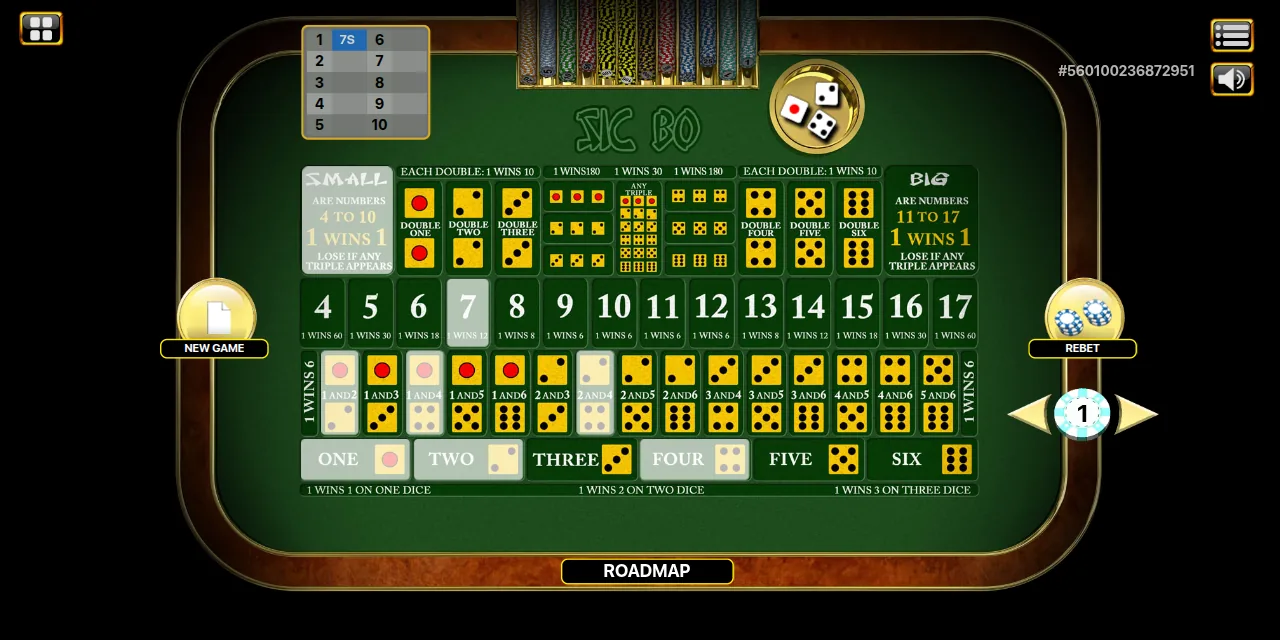
What an RNG sic bo game looks like
Screenshots from the free demo version on the studio’s own website, taken on 13 October 2026. The play-money status bar of the game has been cropped off.
Is online sic bo legal in Canada?
It depends on your province. Under the Criminal Code only a provincial government can conduct and manage online gambling, so each province decides who may offer casino games such as sic bo. Ontario has run an open market of registered private operators since 4 April 2022, and Alberta opened its own on 13 July 2026. Most other provinces offer online casino games through a single Crown platform, and the territories have no online casino platform. Our guide Are online casinos legal in Canada? covers each province, its regulator and its minimum age.
Frequently asked questions
Play within your limits
Sic bo is a game of chance and the house edge applies to every roll. Set a time and money limit before you start and treat any spend as the cost of entertainment. 19+ (18+ in Alberta, Manitoba and Quebec). Free, confidential help: ConnexOntario 1-866-531-2600, and every province’s helpline is on our responsible gambling page.