Online Video Poker in Canada
How a hand of video poker works, how the hands rank and why two games with the same name can return very different amounts. Compare Jacks or Better paytables and practise the standard holds in the tools below.
Illustration only: five random cards from a full 52-card deck, with the hand they make. No bets, no money and no balance. Every deal is independent of the one before.
- 52 cards in a Jacks or Better deck, shuffled again for every hand
- 99.54% return on 9/6 Jacks or Better with optimal strategy: still below 100%
- 95.00% return on 6/5 Jacks or Better, the same game with a weaker paytable
What online video poker is
Video poker is a single-player game of five-card draw. You are not playing against other people or a dealer: the game deals five cards, you choose which to keep, and the final hand is paid according to a fixed paytable. Online, a random number generator (RNG) shuffles a fresh virtual deck for every hand.
- 1
The deal
Five cards come from a standard 52-card deck (53 with a joker in Joker Poker). About half of all first deals contain no pair at all, and a pair of jacks or better comes up in about 13% of them.
- 2
The draw
You hold any number of the five cards, from none to all of them. The rest are replaced from the 47 cards still in the same deck. There is one draw per hand; the result after it is final.
- 3
The paytable
Every paying hand has a fixed payout shown on screen, such as 9 for 1 for a full house. The paytable sets the game’s return; your holds decide how close you get to it, never above it.
How a round works
Every round of single-hand video poker follows the same five steps. There is no timer and no other player, so the pace is yours.
Check the paytable and set a budget
Look at the full house and flush lines and the RTP in the help screen before the first hand, and decide in advance how much you are prepared to spend.
Choose the bet
Most games use a coin value and one to five coins per hand. The royal flush usually pays more per coin at five coins, which is why published returns assume five coins.
Deal five cards
The game shows five cards face up. A hand that is already on the paytable is usually highlighted in the table.
Hold and draw
Tap the cards you want to keep, then press draw. Every card you did not hold is replaced by a new card from the rest of the deck.
The hand is settled
The final five cards are compared with the paytable. A paying hand returns the amount shown; anything below the lowest line returns nothing. The next hand starts from a newly shuffled deck.
Video poker hand rankings
The hands rank as in regular poker. The table shows the 9/6 Jacks or Better payouts, quoted “for 1”: the amount returned for each unit bet, including the bet itself, so 1 for 1 means the bet comes back. The last column shows how often each hand is dealt in the first five cards, before the draw.
| Hand | Example | Pays on 9/6 Jacks or Better | Dealt in the first five cards |
|---|---|---|---|
| Royal flush | A♠ K♠ Q♠ J♠ 10♠ | 250 for 1, 800 for 1 at five coins | 1 in 649,740 |
| Straight flush | 9♥ 8♥ 7♥ 6♥ 5♥ | 50 for 1 | 1 in 72,193 |
| Four of a kind | 7♣ 7♦ 7♥ 7♠ K♦ | 25 for 1 | 1 in 4,165 |
| Full house | Q♠ Q♥ Q♦ 4♣ 4♠ | 9 for 1 | 1 in 694 |
| Flush | K♦ 10♦ 8♦ 5♦ 2♦ | 6 for 1 | 1 in 509 |
| Straight | 10♣ 9♦ 8♠ 7♥ 6♣ | 4 for 1 | 1 in 255 |
| Three of a kind | 8♠ 8♥ 8♦ K♣ 3♠ | 3 for 1 | 1 in 47 |
| Two pair | J♣ J♦ 5♠ 5♥ A♣ | 2 for 1 | 1 in 21 |
| Jacks or better (a pair of jacks, queens, kings or aces) | Q♥ Q♣ 9♠ 6♦ 2♣ | 1 for 1 | 1 in 7.7 (13.0%) |
| Anything lower (a pair of tens or lower, or no pair) | 10♥ 10♠ 8♣ 4♦ 2♠ | 0 | 79.4% of deals |
Frequencies are exact counts out of the 2,598,960 possible five-card deals. An ace can play high (10-J-Q-K-A) or low (A-2-3-4-5) in a straight.
Paytables: the same game, different returns
Jacks or Better tables are named after two lines: what a full house and a flush pay for 1. The rest of the table is almost always the same. Pick a paytable to see the return with optimal strategy, the house edge it leaves and what that costs on average.
| Hand | Pays for 1 |
|---|---|
| Royal flush At five coins; 250 with one to four | 800 |
| Straight flush | 50 |
| Four of a kind | 25 |
| Full house Varies | 9 9 on 9/6 |
| Flush Varies | 6 6 on 9/6 |
| Straight | 4 |
| Three of a kind | 3 |
| Two pair | 2 |
| Jacks or better | 1 |
Jacks or Better 9/6
Called full pay: 9 for 1 on a full house and 6 for 1 on a flush. Even with every hold made perfectly, the return stays below 100%, so the game keeps an edge.
What the paytable costs over a session
- Jacks or Better 9/6 0.46% house edge with optimal strategy C$2.30
- Jacks or Better 8/5 2.70% house edge with optimal strategy C$13.50
- Jacks or Better 7/5 3.85% house edge with optimal strategy C$19.25
- Jacks or Better 6/5 5.00% house edge with optimal strategy C$25.00
The figure is the long-run average the game keeps from the total amount bet, assuming every hold follows optimal strategy at five coins; holding mistakes or fewer coins make it higher. It is not a prediction: a single session can end well above or well below it. Money that is bet again counts towards the total every time it is bet.
Which cards would you hold?
Holds are the one decision in video poker, and they change the long-run return only within the limits of the paytable. Pick an example hand or a random one, tap the cards you would keep and compare them with the standard hold from a published simple strategy for 9/6 Jacks or Better. It is a practice tool with no money involved, and the next cards are always random.
Which cards would you hold?
Tap or click the cards you would keep, then show the standard hold for 9/6 Jacks or Better.
Holding nothing is also a choice: it means drawing five new cards.
Source: the simple strategy published by the Wizard of Odds. Followed exactly on 9/6 Jacks or Better, it returns 99.46% over the long run, against 99.54% for perfect play. Both are below 100%, and no hold changes which cards come next.
Simple strategy, 9/6 Jacks or Better
Keep the highest line your five cards match. High cards are jacks, queens, kings and aces.
- 1 Four of a kind, straight flush, royal flush
- 2 4 to a royal flush
- 3 Three of a kind, straight, flush, full house
- 4 4 to a straight flush
- 5 Two pair
- 6 High pair (jacks or better)
- 7 3 to a royal flush
- 8 4 to a flush
- 9 Low pair (tens or lower)
- 10 4 to an outside straight
- 11 2 suited high cards
- 12 3 to a straight flush
- 13 2 unsuited high cards (with more, the 2 lowest)
- 14 Suited 10 with a J, Q or K
- 15 One high card
- 16 Discard everything
The main variants
Video poker lobbies are built on a handful of base games, often also offered in multi-hand form. Each one has its own paytable and its own strategy, so a hold that is standard in one game can be a mistake in another.
The base game: a standard 52-card deck, and a pair of jacks or better is the lowest paying hand. The 9/6 table returns 99.54% with optimal strategy; 8/5, 7/5 and 6/5 versions are common online and return less.
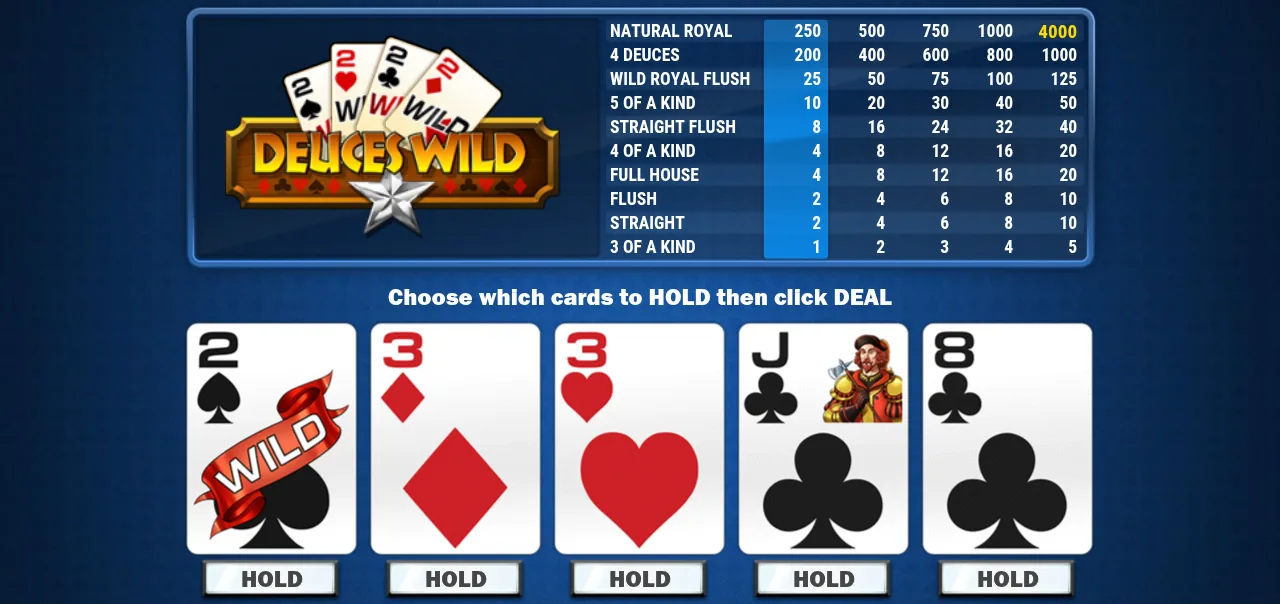
All four 2s are wild and can stand in for any card. Because strong hands come up far more often, the lowest paying hand is three of a kind, and a royal flush without deuces pays much more than one made with them. Paytables vary widely, and the strategy is completely different from Jacks or Better.
A 53-card deck with one joker that works as a wild card. Depending on the version, the lowest paying hand is a pair of kings or two pair, and five of a kind joins the top of the paytable.
Jacks or Better with the lowest paying pair moved down to tens. Because a pair of tens now pays, the full house and flush lines are set lower to balance it, so compare the RTP rather than the name.
A Jacks or Better variant that pays extra for four aces and for four jacks, queens or kings. The full house and flush lines are usually lower than on 9/6 Jacks or Better, and a few holds change.
You hold cards once and the held cards are copied to 3, 5, 10, 50 or even 100 hands, each of which draws its own replacement cards. The bet is multiplied by the number of hands; the paytable and the return per hand stay the same, but results swing much more.
What to check in the help screen
- The paytable and the RTP
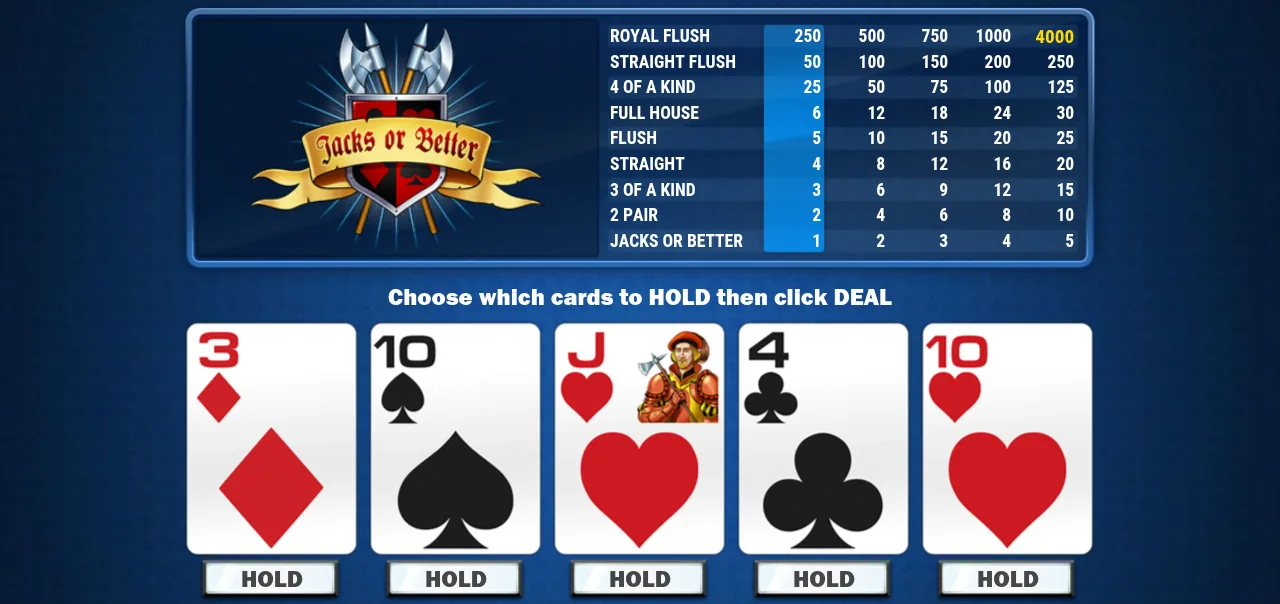
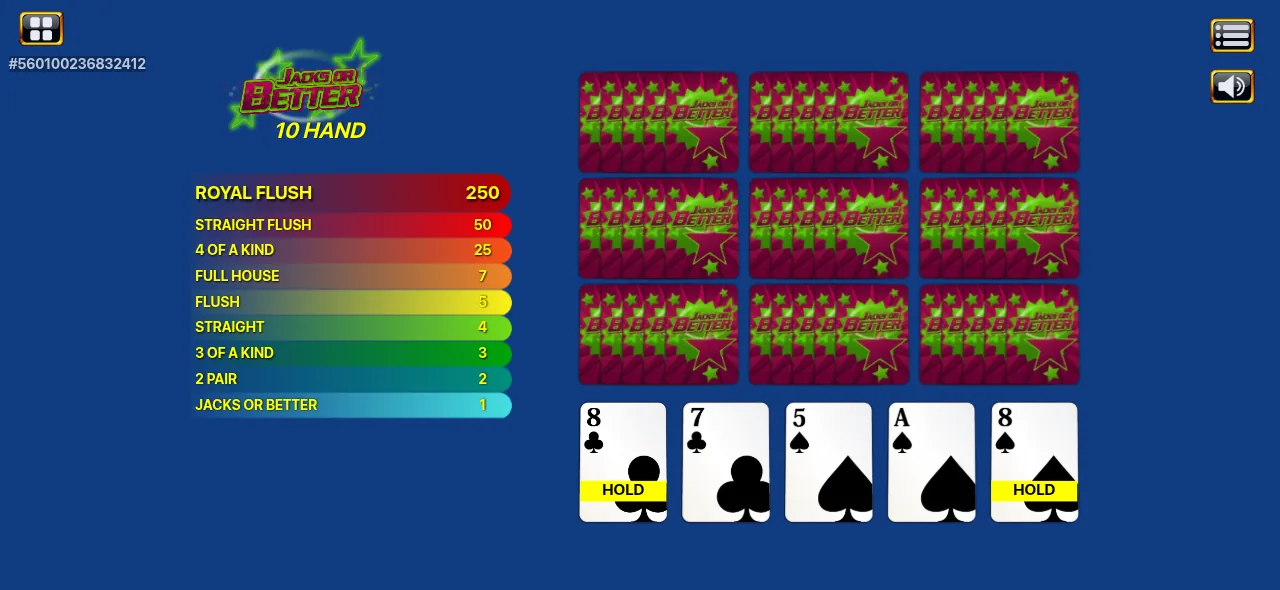
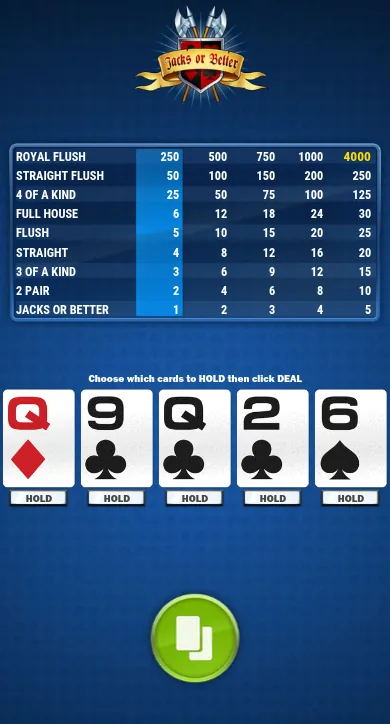
Read the full house and flush lines and the return to player (RTP) stated in the game’s help or paytable screen. Game titles say nothing about it: the two Jacks or Better demos pictured below use 6/5 and 7/5 tables, not 9/6.
- The royal flush at five coins
Check whether the royal flush pays more per coin at the top coin level (4,000 for five coins instead of 1,250 is the usual jump) and whether the stated RTP assumes that level.
- Wild cards and the lowest paying hand
Wild cards change everything: which hands pay, how often they come up and which holds make sense. Check the lowest line on the paytable before you hold anything.
- Optional extras
Some games add an auto-hold button that marks a suggested hold, or an optional double-up round after a paying hand. The help screen explains each one; a double-up round puts the amount just paid at stake again on a new chance.
What the games look like
Screenshots from the free demo versions on the studios’ own websites, taken on 13 October 2026. The play-money status bar of each game (coins, bet and balance) has been cropped off.
Is online video poker legal in Canada?
It depends on your province. Under the Criminal Code only a provincial government can conduct and manage online gambling, so each province decides who may offer casino games such as video poker. Ontario has run an open market of registered private operators since 4 April 2022, and Alberta opened its own on 13 July 2026. Most other provinces offer online casino games through a single Crown platform, and the territories have no online casino platform. Our guide Are online casinos legal in Canada? covers each province, its regulator and its minimum age.
Frequently asked questions
Play within your limits
Video poker is a game of chance: every deal is random, and even perfect play on the best Jacks or Better paytable returns less than 100%. Set a time and money limit before you start and treat any spend as the cost of entertainment. 19+ (18+ in Alberta, Manitoba and Quebec). Free, confidential help: ConnexOntario 1-866-531-2600, and every province’s helpline is on our responsible gambling page.